
With the world engulfed in a global pandemic climate change, the environment seems almost overlooked. A vaccine will likely put an end to this pandemic while the environment will continue to be at risk.
With economic woes caused by the pandemic politicians ponder whether to invest in fossil fuels that had already lost value in worldwide commodities. Other politicians think that rekindling the economy means giving developers a free rein and let urban sprawl continue.
The pandemic has even generated its own pollution with thousands of masks discarded on city streets. Where does all the medical PPE go after use? This is certainly not the time to let our guard down on the environment but perhaps just the opposite.
The pandemic has given us time to stop and reflect and look around to appreciate what we have. With the urban lock-downs in many cities, people have literally been treated to a breath of fresh air as air quality improved if only briefly.
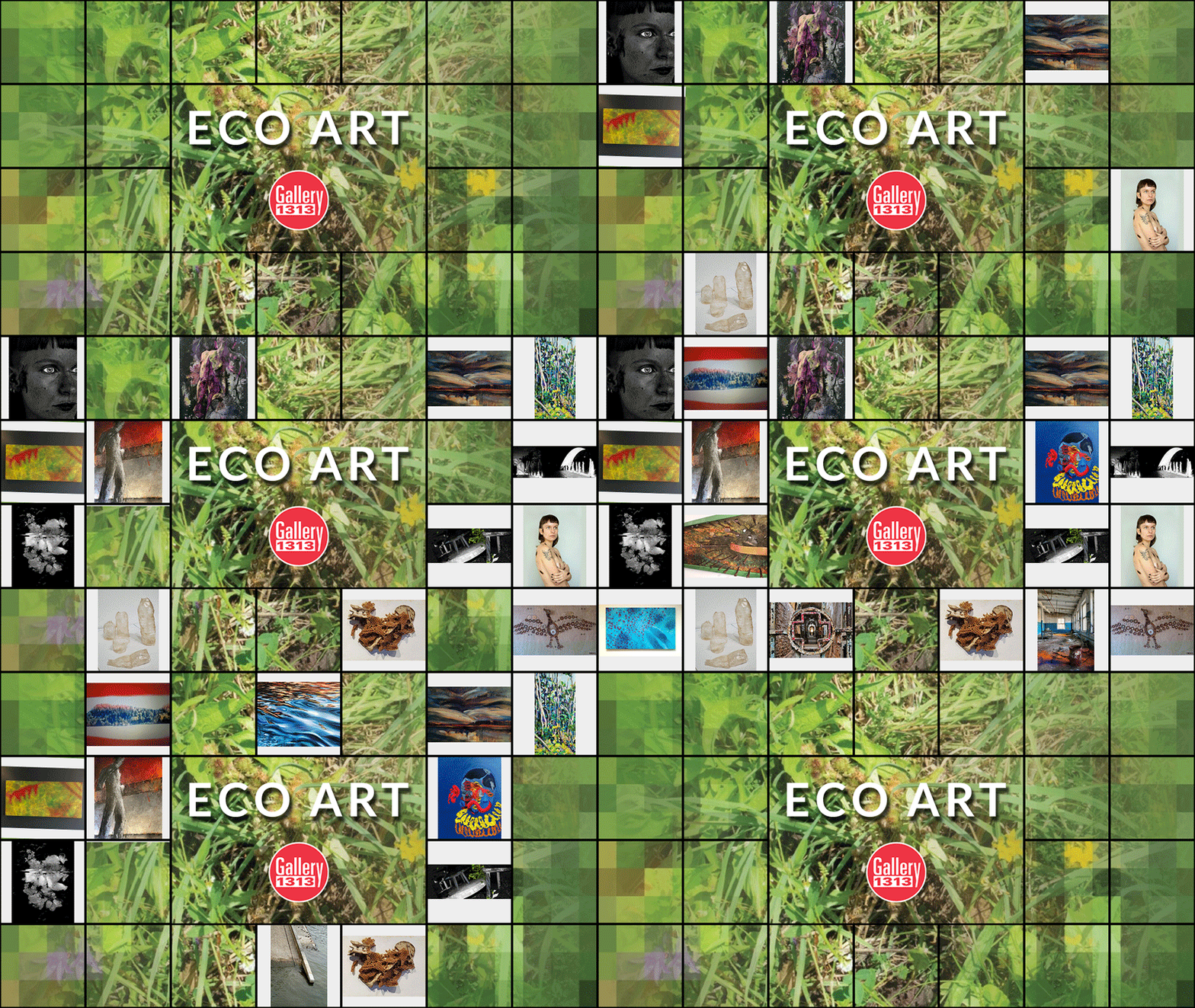
This exhibition gives artists the opportunity to voice their concerns and remind us of how fragile our environment really is. The collection of works curated by Phil Anderson is comprised of artists exploring environmental issues such as urban sprawl, water quality, air pollution and other issues. The work has been created in various practices and disciplines.
There will be a reception August 20 by invitation 6:30-8pm and COVID-19 protocols will be enforced including pre-screening of visitors, wearing of masks and social distancing. Limit of 10 visitors at a time.

Sheila Thompson
- Habitat 2050 Glaciers Melting
- 14″x14″
- Handmade wool, silk and paper felt
I imagine future geographies 30 to 100 years out and sound a warning about the unintended consequences our careless actions have on the natural world.

Sheila Thompson
- Leaf In Response to #5
- 23″Hx10″Wx2″
- Handmade wool and silk felt
Will outlandish leaves and trees populate the new landscapes? how will leaves respond to differing environmental pressures? Will our natural landscapes become more fragmented, more homogenous? how will the geographic distributions of our vegetation change?

Paul Kilbertus
- Canada Goose
- 12×28 inches
- collage made from found objects
Capturing an image or moments drives my art. I hope it gets you to look again, to notice or think about what you may have stopped noticing. I usually begin with images I capture with a camera. I use the possibilities of acrylic paint and products to push the interpretation. I also paint on surfaces other than canvas to create some other layers of meaning – wood, maps, money, plastic, garbage..

Marta Stares
- Last Day of October
- 2020
- 48 x 36 in
- Oil on canvas
During the pandemic, I have been interested in learning about the environmental impact of a global shut-down, especially as it pertains to animals and oceans. Reduced marine traffic and noise has positively impacted sea life, whereas discarded single-use masks are contributing to more ocean pollution.

Marta Stares
- Find me on the Water
- 2020
- 48 x 36 in
- Oil on canvas
Being in quarantine has allowed me to reflect on my own connection with water and the ways in which my personal actions contribute to an ongoing environmental crisis.

LEALA HEWAK
- Collision
- 2019
Working in non-traditional photo-documentary and collage, part of my practise focused on the Modernist/Brutalist landscape. “Secret Fountains” is a series documenting a raft of abandoned Modernist fountains in my mid-Toronto neighbourhood.

LEALA HEWAK
- Fountain No. 10
- 2017
These crumbling concrete relics once provided cool, elegant enjoyment for the tenants of a large apartment complex. The fountains are now demolished, making way for multi-million-dollar townhouses directly next to the apartment buildings. This destruction of the man-made environment wastes substantial capital already spent on humanizing the urban landscape.

Kerry Brownell
- Ocean Micro Plastic Cancer
- acrylic and oil on canvas
- 36″ x 60″
The intention in my painting practice is to have the viewer question the hidden meanings found in the layers of my compositions not just remain on the surface, to explore the fragility of nature through the use of transparency and light.

Kerry Brownell
- Tranquility and Tension
- acrylic and oil on canvas
- 24″ x 48″
Instead of a conventional sketchbook, my process employs my graphic design skills to digitally manipulate multiple photos and use these images as inspiration in the creation of a new composition. Through the process of applying multiple thin layers of paint a transformation occurs, and the viewer’s perception of reality is distorted.

LISA LITOWITZ
- Birch Madness 2
- 2019
- Acrylic on canvas
- 60″ x 30″
My art amplifies the splendour of trees – celebrating their colour and natural beauty whether tangled, bruised or bent – they are the link of life for past, present and future generations.
- Instagram @lisalitowitzart
- lisalitowitzart.com

LISA LITOWITZ
- Tangled Trees
- 2019
- Acrylic on canvas
- 60″ x 30″
Urban sprawl and pollution are a major threat to our trees as they die from disease, overcrowding, and rampant removal for development. Trees are vital habitats for animals and birds while they provide oxygen, shelter and reduce carbon in a time of global warming. Let’s choose trees over parking lots!
- Instagram @lisalitowitzart
- lisalitowitzart.com

Catharine Somerville
- The Sky Tunnel
- 2020
- oil on canvas
- 30″ x 24″
I consider the beauty and spirit of the natural world using the found colours and sounds often by painting en plein air. The poetry of the ever-shifting landscape bonds me to my imaginings and to my work.

Catharine Somerville
- Lake Dream
- 2020
- oil on canvas
- 30″ x 24″
I take my notes and sketches into the studio where different philosophies enter my thoughts to develop a series of work to capture the awe and energy of what it feels like to be fully present in the moment.

Margaret Stawicki
- Crossin Over
- mixed media
- 32″ x 48″
My practice focuses on human emotions and the passing of time as a source of transformation on us, people. Through abstraction and a narrative painting, use of muted colours, disorienting horizon lines and recurrent symbolism.

Margaret Stawicki
- Tree of Life
- mixed media (oil, copper, cedar shingles)
- 48″ x 48″
My work reflects on personal experiences, on my journey through life, international travel, emigration, starting new life, making choices, choosing the road to follow and always leaving something behind, my journey, when new becomes by fading the old.

Andra Ragusila
- Concrete
- 2019
- Pastel on paper (framed)
- 20″ x 27″
The piece titled Concrete is a grim reflection on the concrete environments we live in, and in which we have found ourselves quarantined in. Drawn on a concrete grey background of rough sanded paper, the figure is emerging, or rather in dissolving into the concrete background. This time of staying inside for prolonged periods of time has led to a loss of separation from our built environments, while simultaneously experiencing a loss of identity and a deep rift from the natural world.

Pam Patterson
- Boy
- 2019
- Digital photo, drawing, print
- 24″ x 36″
How can we, as humans, reassemble and be reconstituted as a result of the anthropogenic changes affecting our world such as COVID-19? Does this event mark a severe ecological discontinuity to what we have come to expect as our “healthy” planet?
Everyday life has shifted us to a deeper dependence on the digital, the screen, the loop. The concepts of “normal” are transformed. As “boy”, I am here represented in found photo and drawing. Green is no longer the colour marker of a planet rich in resources but rather of one which has been disabused. “Boy” gazes out in bewilderment.

Avleen Kaur
- How to be human
- oil on canvas
- 36″ x 48″
My work addresses the human traumas and tribulation through a visual medium. I paint about the physical human experience and its effects on us internally. Identifying strongly with existentialism and living through the absurdity of human life, I seek to sing a visual poem for those going through the same crisis.

Avleen Kaur
- Call me Ill pickup I promise
- oil on wood
- 36″ x 36″
The art that I create is undulating between nihilistic and existentialist angst that we embody and lived through the pandemic. The turbulent inner conversation that was created as an ongoing sequel of this existence is what I try to radiate through these paintings, while juxtaposing realism and surrealism in one space. Chaos of bright colors and aggressive execution of paint application tries to display these difficult emotions.

Neil Joseph Polson
- In/Land video
This video was created in 2010 during a period of personal healing and growth. It depicts appreciation of the environmental beauty that is still available to witness. This video hopefully reminds us of the importance of maintaining the earth during this crucial time.

Andrew Lindell
- Sandbox
- Old sandbox base Square nails,copper, oils, earthpigments.
- 8-5/8” x 39- 1/2”
- $180.00
Our future belongs to our children give them the best education possible. If you do not have a forest give them a giant sandbox to discover, challenge, get along with others and maybe a few scrapes and bruises to prepare them for a thriving life.

Oumou Nasri
Collection Earth Collaborative
- Earth (1/2)
- Photo Print on Canvas
- 12″ x 15″
The fragility of our way of life has become apparent in light of the COVID-19 pandemic and climate change. What holds us together as a society becomes ever so precious and, somehow, nostalgic.

Oumou Nasri
Collection Earth Collaborative
- Earth (2/2)
- Photo Print on Canvas
- 11″ x 15″
Oumou Nasri is a collaborating artist with Connection Earth Collaborative founded at the Ontario College of Art and Design University in Toronto. A graduate of the University of Applied Sciences in Berlin, she creates work day to day regarding life and nature.

Oumou Nasri
Collection Earth Collaborative
- Du Sang Et Du Lait
- Photo Print on Canvas
- 11″ x 15″
The fragility of our way of life has become apparent in light of the COVID-19 pandemic and climate change. What holds us together as a society becomes ever so precious and, somehow, nostalgic.

Leena Raudvee
- The air we breathe
- modified digital photo
- 8” x 10”
- 2020
The current pandemic has brought many changes to our local and global environments. In the extraordinary quiet of the first weeks there was hope for a green resurgence as we were reminded of what the world could look and sound like…

Leena Raudvee
- Environmental policy
- oil pastel
- 10” x 8”
- 2020
… but the reopening has revealed a lack of commitment to finding ways to maintain and build on those revelations. As artists we must speak out for a better and greener new normal.

Jasmyne Smith
- City on the Horizon
- 2020
- Textiles, embroidery, found object
- 22.5” x 13.25”
Jasmyne Smith is an emerging artist residing in Hamilton, Ontario. Born in the small town of Wyoming, Ontario; her rural background influences her artistic practice. She is a textile artist, printmaker, and painter. Jasmyne’s art practice focuses on the contrast and competition between urban and rural land mass. Her work highlights urban encroachment, and the significance of agriculture, while leaving the viewer room for interpretation within her deconstructed landscapes.

Stephanie Avery
- Dyeing
- 2018
- Abandoned rubber factory, Saint Petersburg, Russia
- archival print laminated beneath acrylic glass
- 20” x 30”
I travel the world to photograph stunning abandoned buildings. The subjects of my submission embody the destructive power and consequences of our industrial systems (manufacturing, colonialism, power, prison, and war)…

Stephanie Avery
- Red Cross
- 2018
- Abandoned prison, Philadelphia, USA
- archival print laminated beneath acrylic glass
- 30” x 20”
… however, rather than focusing on the negative pasts of these structures, my images show the magnificent capacity we have to heal, and that beauty and hope can be found in even the most unexpected of places.

Joseph Farrugia
- Zuse
- 2018
- Canvas Panel, Wax, Turkey Bone, Propolis-Shellac
- 8” x 10”
“Incarnation” is a series of paintings created by millions of honey bees, in collaboration with artist and apiarist Joseph Farrugia. Humans have drawn energy and inspiration from honey bees for thousands of years and this primal relationship lays at the heart of this series. From ancient Egyptian pharaohs to medieval monks to NASA scientists, honey bees have been looked to as examples cooperation, order and a connection to our environmental health.

Joseph Farrugia
- Cronos
- 2018
- Canvas Panel, Wax, Shells, Propolis-Shellac
- 8” x 10”
The bond between us and bees has broken in recent years and the majority are in a crisis right now. “Incarnation” draws viewers attention to one aspect of the Anthropocene extinction unfolding, by displaying honey bees stunning fabrication skills, interlaced with dead or shed natural materials (bones, antlers, shells, feathers) and given allegorical references.

Ruth Hartman
- The levers might not be in our hands.
- A photograph taken in another time reflect the new world we inhabit in 2020.
The domesticity of a Weimar window becomes a symbol of confinement with dead air and the invisible threat of Covid 19 lurking on either side.

Ruth Hartman
- When waters rise, even ducks stake out high ground.
- A photograph taken in another time reflect the new world we inhabit in 2020.
With polar ice caps and glaciers melting, ducks on the Seine challenge the assumption that humans have their environment under control and can survive climate change without action.

HILARY HUNG
- Bottles
- 2019-2020
- Biodegradeable plastic made from water, tapioca starch, glycerin, vinegar
- 13” x 12” x 12.5” installed
The Plasticity series is a biodegradeable index of plastic containers consumed daily. The sculptures themselves are made from consumable food items: water, tapioca starch, glycerin and vinegar.

HILARY HUNG
- Trash Can
- 2019-2020
- Biodegradeable plastic made from water, tapioca starch, glycerin, vinegar
- 6” x 9.5” x 13”
With the original objects sourced from missorted garbage bins and the casted sculptures designed to biodegrade in weeks’ time, Plasticity questions the environmental impact of our reliance on plastics and the ecological footprint of artmaking. The materiality of tapioca bioplastic continuously shifts and shrinks after drying, reflecting the changing fragility of our environment.

Gulay Alpay
- Deep Breath
Gulay Alpay is an imaginative and innovative artist who has developed a reputation for poetic epic works that display both delicacy and fragility. There’s not a single corner, hard-edged, geometric line to be found in her composition, instead, the shapes are as fluid as the submerged sounds that fuel her imagination.

Gulay Alpay
- Earth Born
In her exhibitions and shows, as a result of her interactive approach, the artist and visitor
can both exist inside the picture and therefore exist within the artist’s state of creation.

Tina Faucher
- Goat Plague Part One
The causes and effects of climate change are intertwined – until we break the cycle.
Five Anthropogenic zoonic outbreak causing factors, identified by the UN:
- Rising demand of animal protein
- Exploitation of wildlife
- Intensive and unsustainable farming practices
- Gross depletion of natural resources
- Climate change

Tina Faucher
- Someone’s Watching
Can we see ourselves in the eyes of the animals we exploit? If we don’t redefine our relationship with the earth and our fellow earthlings, how long will we last?