
MAIN GALLERY
Reception: Thursday, October 10, 6:30 pm
Artist Talk: Sunday, October 13, 2:00 pm
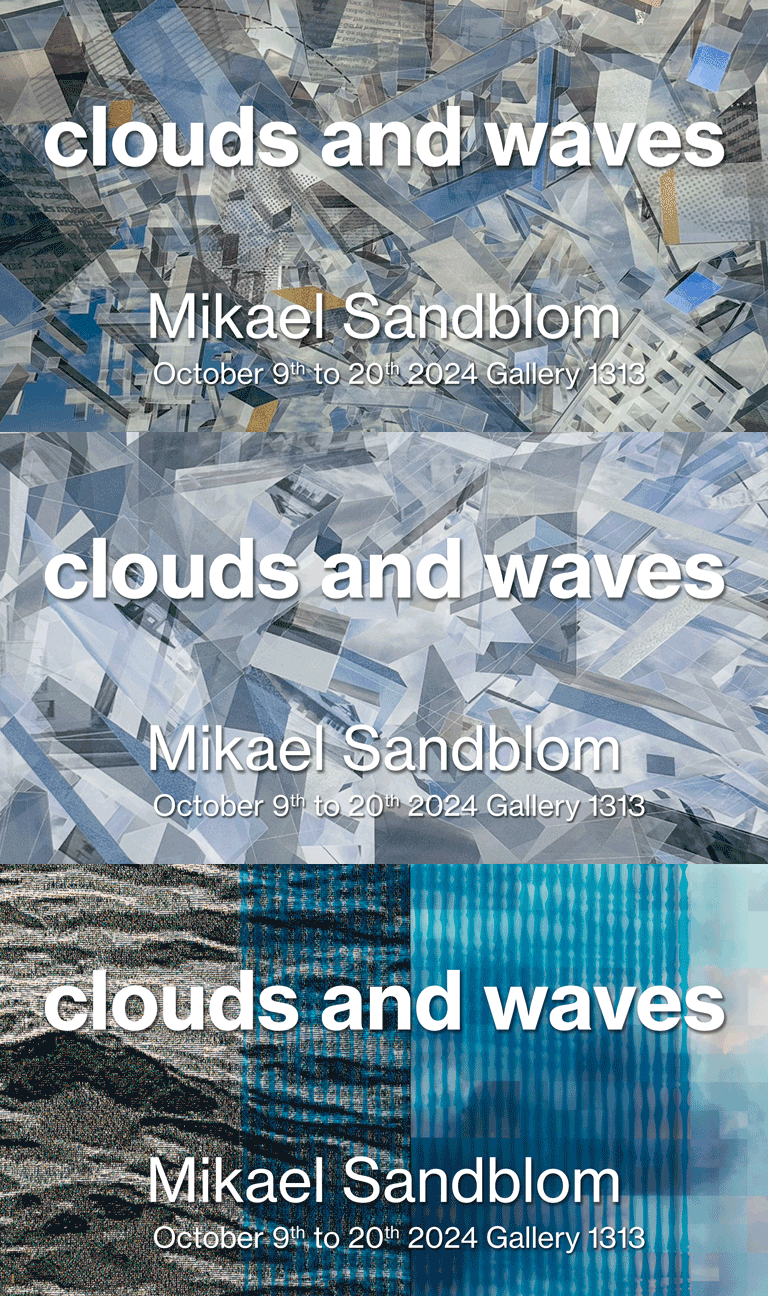
Mikael Sandblom’s exhibition Clouds and Waves at Gallery 1313 extends the contemplation of the landscape into a deeper exploration of memory, perception, and the nature of consciousness.

Sandblom’s work is based on extensive observations of the sky and the surface of water, of clouds and waves. Rather than a literal depiction of these phenomena, the artwork represents the experience of sustained attention interwoven with a free-associative state of mind that is induced when you look at nature very carefully.

Images in the show are derived from photography, 3D software, and other computer graphics. The artwork itself is executed in a variety of media including painting, textiles, and digital prints on opaque and transparent surfaces. The wide variety of modes of representation encourages one to notice the act of reading an image; to become aware of how the depicted subject, and by extension, all reality is constructed in the mind. Coloured thread in a tapestry or a simple graphic of lines can both become waves on water far beyond the surface of the material. Clouds become mountains, cities, and the spaces where the past is recalled and re-enacted.

Contradictory geometries materialize and dissipate, while fragments of memory intermingle with imagined structures. The art pieces embody a form of dream logic, positioning the viewer as an active participant in the creative process.

Approach Sandblom’s artworks as you would observe clouds and waves outdoors. Allow yourself to become immersed in their geometric complexity, and remain attentive to the unexpected pathways your thoughts may explore.
Flip Through the Show Catalogue
Read a review of this exhibition at artoronto.ca

Installation Views


Reference Frames
A collection of possible approaches and branching paths:
hallucination
It’s an innate compulsion. You can’t stop interpreting. There’s a racoon over in that corner. No, it’s a dog. No, it’s a broken flowerpot. Up close, it’s definitely a broken flowerpot. Your mind projects ideas until it finds the best fit. There’s a flash of vertigo when one hallucination is swapped out for another.


irreal
You know that the earth is a rotating sphere, but it does not feel that way. You’re standing on a fixed, flat, solid, earth where the sun rises and sets. Physics, chemistry, psychology – they tell you your intuitive version of what’s ‘real’ does not line up with the facts. This contradiction evokes the feeling or irreality.
mind’s eye
The mind’s eye keeps things simple; glosses over the details. Test yourself. Focus on the motion of waves on water. Try to decipher the structure. Follow just one wave. You’re soon overwhelmed! It’s nothing like the simplified version you thought you knew. You weren’t really seeing at all.


time traveller
Clouds are a catalyst for time travel. Wander through childhood rooms; reconnect with old friends. You go wherever and do whatever you want. Clouds set you free to float through time and space.
singularity
You go back and forth. You see the surface, the material, lines, shapes, and textures. And then it flips. You see through the surface to a world beyond, the illusion of another place. You can return across this threshold, but you can never stop at a single point where you see both at the same time.


future past
These clouds. These waves. They are unique and fleeting; ephemeral. And yet eternal. Clouds flew above the earth long before there were people and will continue long after we are gone. Each wave follows the pattern of all its ancestors and descendants.
What is it like to see?
That’s an odd question you might think, we all know what its like to see. We’re doing it right now.
But when I look closely at waves on the water, I try to follow them with my eyes. Well, that’s too hard so I follow just one but quickly I lose it amongst all the others.
And if I stare at the clouds I try to see and remember their shapes. I imagine buildings, landscapes, and creatures, but I can’t see the entire sky and before I can take it all in, everything has changed. I can’t find where first I started.
If you look at a landscape, a painting or photograph, you can see all those details at once. You can see the shapes of clouds and the pattern of waves. In one way you can now see more because time is frozen. But in another, more accurate way, you see much less because time is frozen!
We can perceive less than we think we do. The actual area of detail vision that we see is a very narrow cone. It is the size of your thumbnail at arm’s length. Fovea Centralis. The detail in the rest of your field of vision declines rapidly as you move away from the centre towards the periphery.
So how can we experience such a complex and detailed environment? If I only see a thumbnail’s worth of detail, how can this room seem so intricate? Full of people and art? If we’re stuck with such limited inputs? The answer is that we’re making it up! Our brain builds a model of what the world is like and then our senses just check for accuracy and provide updates and corrections. Bayesian inference it’s called. The world we experience is a hallucination. – fact checked buy the senses.
This is not my idea by the way; it’s based on the research of neuroscientists such as Anil Seth.

I wanted to play with this idea – that we create the image of the world. In these pictures, your mind goes between seeing the material, the fabric the lines and seeing through to the image – that is constructed in the mind. And with these different surfaces and representational modes, you never ‘see’ everything at the same time. Not just material, not just waves, not just clouds not just Plexiglas layers. The work is always changing as you look at it – as you switch from one mode to the next.

These cloud structures are based on sightings from my cloud observatory as I call it – which is really anywhere I can see the sky. They are based on the imaginary architecture I’ve projected onto the clouds. But they’re also cloud-like in that the shapes within them break apart and contradict each other.
A visual reference here is also something I occasionally experience – an ocular migraine aura. It’s a phenomenon in the visual field that causes me to see shimmering patterns of crystalline structures for twenty minutes or so. An internal experience that only I can see – but then again so is every experience of the world if we accept the idea that each individual creates their own reality.

In these pieces fragments of architecture appear. They are again based on the structures I imagine in the clouds – clouds are like Rorschach tests – you see what is on your mind and what interests you. In this case the structures are historical buildings from around here such as the Meaford station and an old Wheelbarrow factory. All the architecture I reference here has been torn down. The point being that even things around us that seem solid and permanent such as buildings are really only temporary, ephemeral structures in a longer time frame.
Perceiving creates the world. By looking carefully, we discover that we often unnecessarily narrow our experience of what is possible. At the same time, we make the mistake of believing that the world we conjure with our minds is complete, solid, and permanent. What we see is not all there is.


Leave a Reply